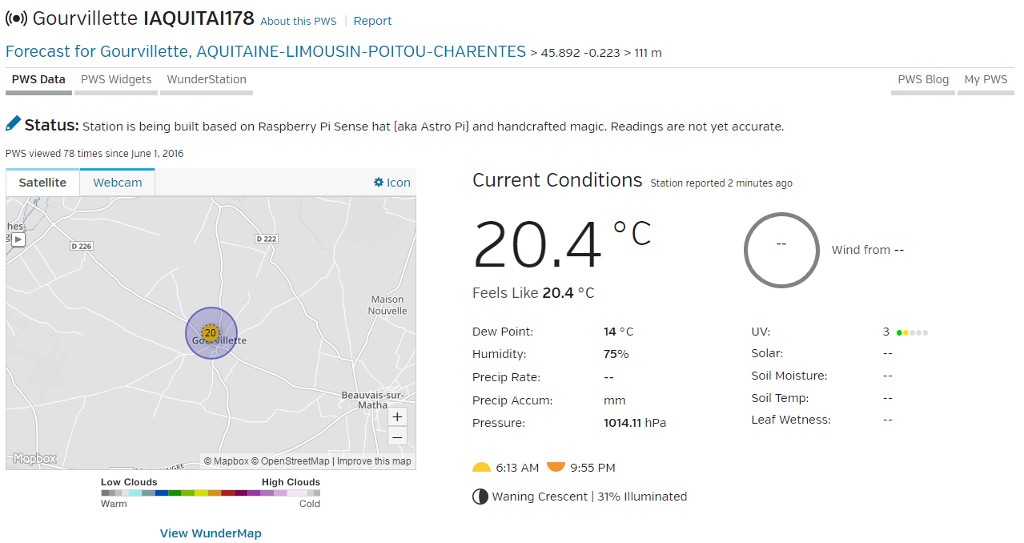
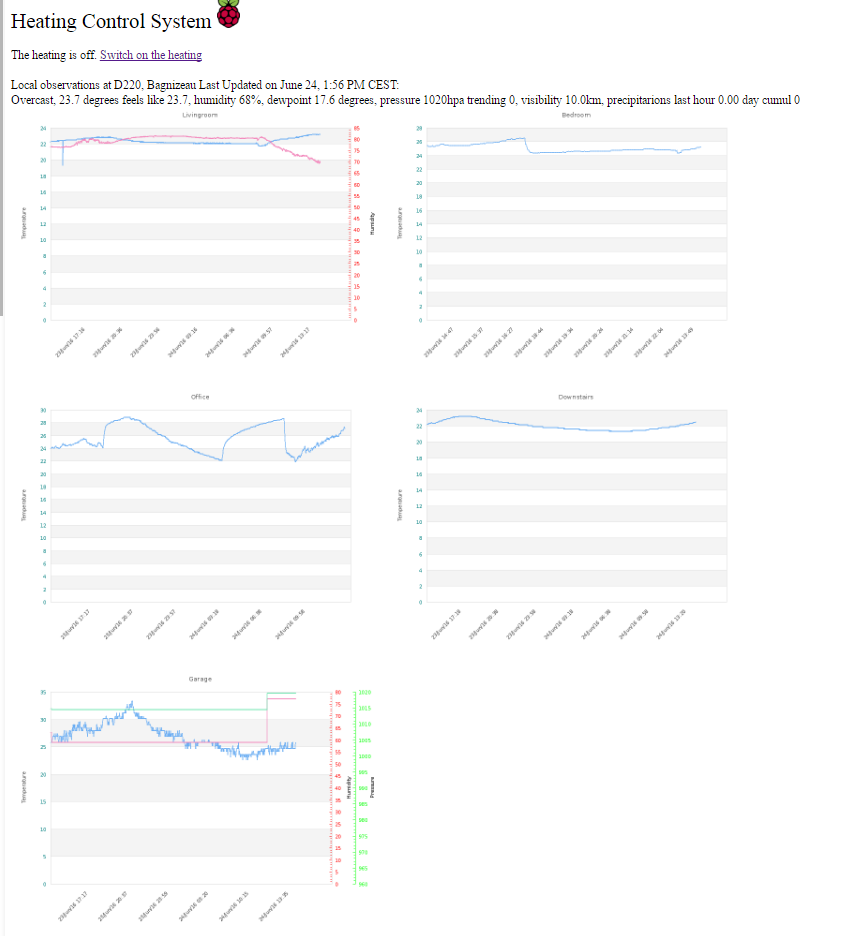
For the software side, I wanted to: log the data with the other Pis via the RadPi system, and publish the data to Weather Underground.
Pour le logiciel, je voulais : enregistrer les données avec les autres Pi via le système RadPi, et publier les données sur Weather Underground.
Python: reading sensor data
Python : lecture des capteurs
from sense_hat import SenseHat
sense = SenseHat()

# Température du CPU
with open('/sys/class/thermal/thermal_zone0/temp') as f:
    tempC = float(f.read()) / 1000

# Capteurs du Sense Hat
t1 = sense.get_temperature()
t2 = sense.get_temperature_from_pressure()
t3 = sense.get_temperature_from_humidity()
p  = sense.get_pressure()
h  = sense.get_humidity()

# Correction de la chaleur du CPU
avgtemp  = (t1 + t2 + t3) / 3
calctemp = avgtemp - ((tempC - avgtemp) / 10)
calchum  = h + 4
calcp    = p + 6

# Sauvegarder pour le serveur RadPi
with open('/var/www/html/temp.html', 'w') as f:
    f.write(f'{calctemp}!{calchum}!{calcp}')

# Afficher sur l'écran LED du Sense Hat
sense.show_message(f'T={calctemp:.1f} P={calcp:.0f} H={calchum:.0f}', scroll_speed=0.05)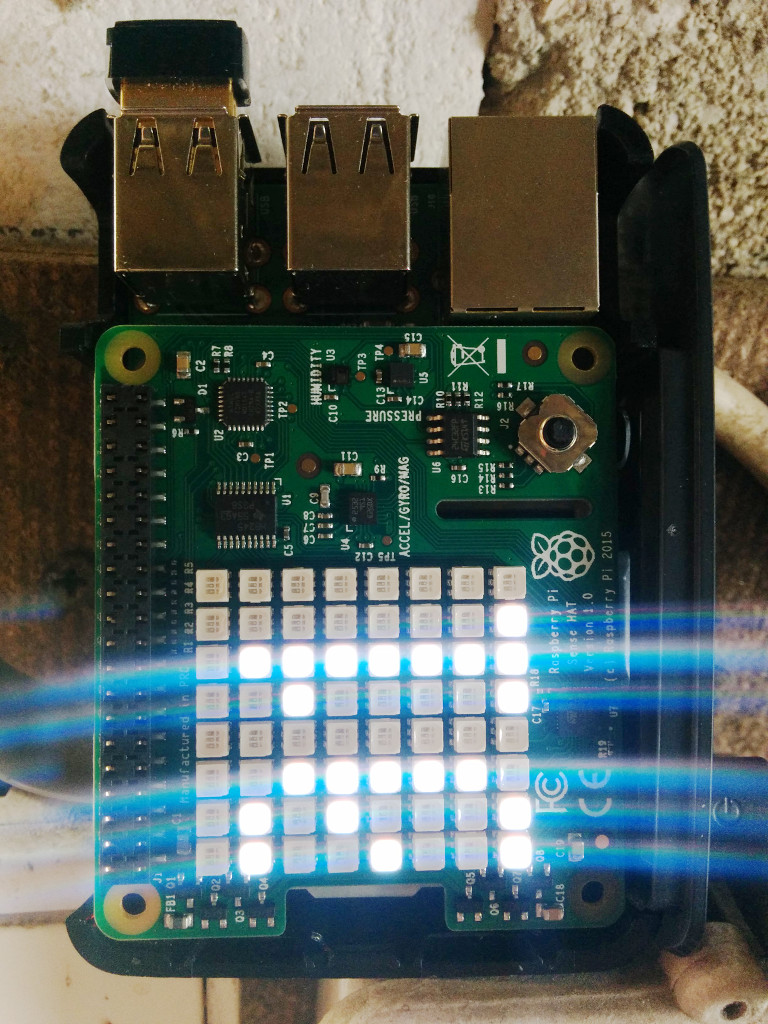
The Sense Hat has a known flaw: sensors are close to the Pi CPU and are affected by its heat. The adjustments above compensate based on readings from a nearby reference station.
Le Sense Hat a un défaut connu : les capteurs sont proches du CPU du Pi et sont affectés par sa chaleur. Les ajustements ci-dessus compensent en se basant sur une station de référence voisine.
PHP: publishing to Weather Underground
PHP : publication vers Weather Underground
<?php
$data = file_get_contents('/var/www/html/temp.html');
$a    = explode('!', $data);
$dew  = $a[0] - ((100 - $a[1]) / 5); // point de rosée approximatif

$url = 'http://weatherstation.wunderground.com/weatherstation/updateweatherstation.php'
     . '?action=updateraw&ID=VOTREIDENTIFIANT&PASSWORD=VOTREMOTDEPASSE'
     . '&dateutc='  . urlencode(gmdate('Y-M-d H:i:s'))
     . '&humidity=' . $a[1]
     . '&tempf='    . ($a[0] * 1.8 + 32)
     . '&baromin='  . ($a[2] / 1000 * 29.5)
     . '&dewptf='   . ($dew  * 1.8 + 32);

echo file_get_contents($url);
?>